
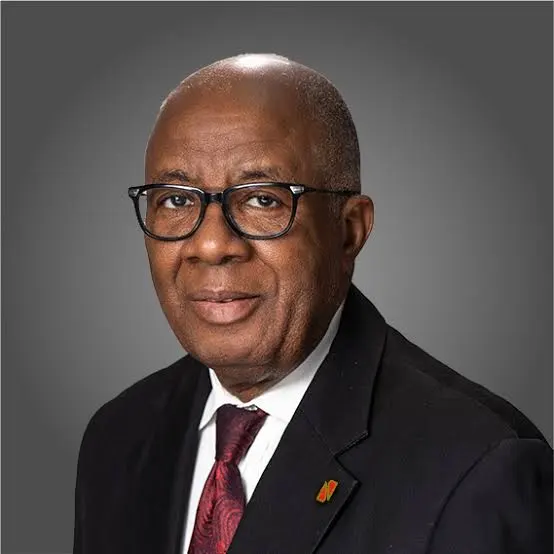
For more than a decade, United Bank for Africa (UBA) Plc has been defined by a singular, cinematic posture: Tony O. Elumelu striding through global financial capitals, preaching the gospel of “Africapitalism.” The charismatic billionaire was the ultimate champion of private-sector-led continental development, turning a Nigerian commercial lender into a pan-African behemoth across 20 countries and four continents, serving 50 million customers.
Yet, the era of the dominant founding patriarch is meeting its institutional boundary. Following a board meeting on Monday, July 6, 2026, UBA announced that Mr. Elumelu will step down as Group Chairman on August 21, 2026. The exit conforms strictly with the 12-year tenure cap for non-executive bank directors mandated by the Central Bank of Nigeria (CBN).
The transition is a watershed moment for West Africa’s financial capital. But by turning inward to elect long-serving non-executive director Emmanuel N. Nnorom as his successor, UBA’s board is signaling continuity over disruption, and structure over flamboyance.
The Operational Fixer
If Mr. Elumelu was the general who conquered territory, Mr. Nnorom is the civil engineer who laid the asphalt. A chartered accountant, a Fellow of the Institute of Chartered Accountants of Nigeria (ICAN), and an alumnus of Oxford University’s Templeton College, the 68-year-old Nnorom belongs to a cohort of technocrats whose careers are measured in ledger balances and risk mitigation rather than headlines.
Yet, within the engine rooms of Heirs Holdings and the Transcorp conglomerate – the core vehicles of Elumelu’s economic empire – Nnorom has long been the indispensable operational fixer. Whenever an enterprise required rigorous structural discipline, he was the man deployed to build the internal framework.
Crucially, his understanding of UBA is granular. Having previously served as UBA’s Group CFO, Executive Director of Risk Management, and the Managing Director/CEO of UBA Africa in 2013, Nnorom did not just watch the bank expand; he designed the internal plumbing that kept it from bursting under the pressure of its own rapid growth.
A Macroeconomic Shift
Mr. Nnorom’s ascension represents a broader, structural evolution across the sub-Saharan financial landscape. The frontier phase of African banking characterized by aggressive, founder-led cross-border asset accumulation is drawing to a close.
Today’s operators face a far more punishing macroeconomic climate. Lenders are grappling with severe foreign exchange illiquidity, stubborn inflationary pressures, and rapid regulatory tightening by central banks seeking to defend local currencies. Simultaneously, agile, well-capitalized fintech firms are aggressively chipping away at traditional banking moats.
In this mature, high-risk cycle, the premium is no longer on rapid geographical expansion. The priority has shifted to cost optimization, robust capital adequacy, and institutional permanence.
“Leadership is not about holding onto a position, but knowing when an institution is ready for the next chapter,” Elumelu noted reflecting on his exit. He endorsed his successor as “a leader of integrity, experience, and sound judgment.” It is a pragmatic calculation: a founder’s legacy is best preserved not by an imitator, but by a disciplinarian.
The Takeaway
When Mr. Nnorom assumes the chairmanship in late August, his primary mandate will be optimization rather than empire-building. UBA’s 25,000-strong workforce needs a steady hand to extract higher returns from existing subsidiaries in volatile markets, while anchoring the bank’s presence in global hubs like London, New York, Paris, and Dubai.
By placing a master of audit, corporate governance, and risk management at the apex of its boardroom, UBA is sending a clear message to institutional investors, international partners, and rating agencies. True economic maturity occurs when the system becomes bigger than the individual. Africa’s financial landscape is moving away from the era of the charismatic pioneer, and firmly into the era of the quiet architect.