
To understand the crisis eroding Africa’s most populous nation is to step into a reality where the lines between state security and state-sponsored terror have entirely dissolved. For over a decade under the All Progressives Congress (APC), Nigeria has undergone a terrifying structural mutation.
To ordinary citizens trapped in this daily gamble for survival, the ruling apparatus no longer functions like a faulty democracy struggling with regional unrest. Instead, it mirrors the cold, calculated control mechanics of Hamas in Gaza or the Islamic regime in Iran systems that systematically utilize, enable, and leverage armed non-state factions to domesticate a population through sheer terror.
The consequences of this administrative abdication are written in staggering human costs. Security data collated by geopolitical analysts like SBM Intelligence reveal a country effectively partitioned into violent fiefdoms. Between mid-2024 and mid-2025 alone, tracking metrics recorded nearly 5,000 abductions in an economy where kidnapping-for-ransom has become a multi-billion Naira industry. Even as the government allocated a historic 5.41 trillion Naira for defense and security in its 2026 budget, Nigeria remains ranked among the world’s least peaceful nations, sitting at a catastrophic sixth globally on the Terrorism Index.
THE ARCHITECTURE OF PARTITION
Like the Iranian regime, which maintains formal ministries while delegating its true enforcement power to radical proxy forces, the APC has mastered the art of semantic shielding and proxy tolerance. The lineage of modern Nigerian terror has expanded aggressively beyond the historical trenches of Boko Haram and the Islamic State West Africa Province (ISWAP). Today, heavily armed pastoralist militias wreak havoc across the North-Central and Southern agrarian heartlands. For years, the federal apparatus sheltered these groups from international scrutiny under the sanitized, legally inert label of “bandits.“
By reducing coordinated, military-grade terror campaigns to mere regional cattle rustling, the government actively delayed the decisive military interventions required to protect its citizens. This semantic shield allowed these militias to establish permanent forest enclaves, acquire heavy weaponry, and paralyze Nigeria’s food supply chain. With land conflicts forcing millions of farmers off their fields, organizations like the UN project that over 33 million Nigerians are facing acute food insecurity. Driven by this engineered scarcity and global shocks, food inflation spiked back up to over 14% in early 2026, turning basic nutrition into a luxury.
THE IRON FIST IN SOUTH EAST
Yet the most alarming dimension of this state-militia nexus is not passive failure; it is active, asymmetrical enforcement. When local communities, left entirely undefended by the state, organize to protect their families and ancestral lands, the APC’s posture shifts instantly from sluggish indifference to lethal mobilization. This dynamic is unfolding with brutal clarity in the eastern part of the country.
In the South-East, under the banner of sweeping anti-separatist counter-insurgency initiatives like Operation Udoka, the federal government has deployed the full weight of the Nigerian Armed Forces not to hunt the invading militias, but to crush local resistance networks.
Throughout communities in Imo, Anambra, and Enugu states, military interventions have frequently morphed into punitive, scorched-earth operations against host populations suspected of harboring self-defense vigilantes. Heavy artillery, indiscriminate raids, and air strikes are deployed against eastern villages, while northern terror syndicates are routinely offered amnesty, financial incentives, and state-backed rehabilitation programs.
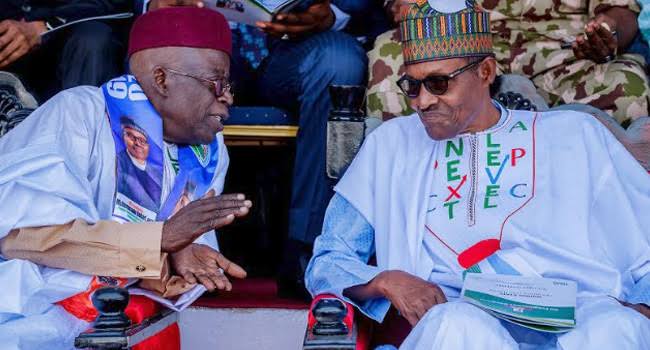
President Bola Ahmed Tinubu and Late President Muhammadu Buhari
By aggressively disarming and criminalizing local neighborhood watches while allowing external militias to operate with relative impunity, the military effectively acts as the enforcement arm for the invaders. The strategic objective is clear: compel absolute pacification. When indigenous populations realize that defending their land means drawing a devastating state military invasion upon their own doorsteps, the architecture of control is complete.
INSTITUTIONAL CAPTURE AND THE DEATH OF THE BALLOT
To focus solely on the physical trenches of the forests, however, is to miss the broader domestic operation. A regime cannot rule via terror from the fringes without completely subverting the democratic infrastructure at the center. The APC’s most critical victory has been the deep, systematic capture of the state’s core institutions specifically the Independent National Electoral Commission (INEC) and the judiciary. What remains on the surface looks like democracy: periodic cycles, colored ballot sheets, and televised rallies. But underneath, the machinery has been gutted.
The last general election exposed how raw physical violence and institutional complicity work hand in hand. In key battlegrounds, particularly Lagos, Imo and River State , armed thugs and partisan militias openly laid siege to polling units. Voters were physically assaulted, ballot boxes were snatched, and ethnic minorities were threatened with death if they dared to queue up. Rather than intervening, state security forces routinely stood by, their passivity serving as a green light for voter suppression.
When the smoke cleared, the institutional capture took over. Despite trillions spent on technological safeguards like the Bimodal Voter Accreditation System (BVAS), the electronic transmission portals mysteriously “failed” at the critical moment, allowing manually altered results to be uploaded days late.
When the opposition petitioned the courts, they ran directly into a barricade. Public trust in the judiciary has cratered as the courts have been weaponized to systematically dismantle opposition leadership structures through highly irregular injunctions. From the election petition tribunals straight to the Supreme Court, judges have relied on rigid technicalities to dismiss staggering evidence of malpractice, effectively legalizing electoral fraud. With recent developments such as the executive branch building luxury housing for judges under the direct supervision of the ruling party’s FCT administration the line between judicial independence and state patronage has vanished entirely.
A FRACTURED REPUBLIC
This calculated asymmetry exposes the fundamental truth of the APC’s governance paradigm. The ruling class does not seek to eradicate terror; it seeks to monopolize it. By utilizing the legitimate instruments of statehood – the national budget, the courts, the electoral commission, and the armed forces to penalize civilian resistance and suppress the electorate while coddling violent proxies, the government has turned fear into its primary tool of social control.
When peaceful citizens marched against this engineered misery during the nationwide #EndBadGovernance protests, they were met with live ammunition and treason charges the exact authoritarian playbook deployed in Tehran. For the millions of Nigerians trapped inside this predatory machine, the gunman in the forest, the compromised judge on the bench, and the politician in the capital are no longer distinct threats. They are simply different gears in the same ruling syndicate, presiding over a nation systematically broken from within.