A month ago Toripost warned that the South African dream had curdled into a xenophobic nightmare, the nightmare has spread, and now planeloads of Africans are fleeing the continent’s most industrialised economy.
When we last told this story, the warning was already stark: the promise that drew millions of Africans south — to jobs, to safety, to a better life in the continent’s richest economy — had soured into fear. That was the cautionary note. What has happened since reads less like a warning and more like its fulfilment.
By early July 2026, the crisis has hardened into something colder and more organised. The vigilante movement March and March, along with other anti-immigrant groups, has spent months organising marches through Johannesburg, Pretoria, Durban and Cape Town, demanding that undocumented foreign nationals leave South Africa by June 30. The date carried no legal force. It became a flashpoint anyway.
THE DEADLINE THAT EMPTIED NEIGHBOURHOODS
The ultimatum did what fear does best: it moved people. More than 3,000 Malawians, including hundreds of children, ended up staying in an open field in South Africa’s port city of Durban, after fleeing escalating anti-immigrant threats and attacks. At the makeshift transit camp, many said going home was the only choice left.
For migrants who stayed, the message was blunt. One organiser told CNN his movement’s slogan amounted to a simple threat: leave, or return in a coffin. It was not idle. Police said two Mozambican men were killed during violence in late May in Mossel Bay, a coastal town in the Western Cape, where more than 50 shacks in an informal settlement were burned. Mozambique later said five of its citizens had died in what it described as “xenophobic attacks.” By the time the June 30 deadline arrived, the latest wave of violence had reportedly claimed at least four lives.
A CONTINENT SCRAMBLES TO BRING ITS PEOPLE HOME
What began as flight has become organised evacuation on a scale rarely seen. African nations including Malawi, Nigeria, Ghana, Zimbabwe and Mozambique have mounted emergency evacuations of their nationals.
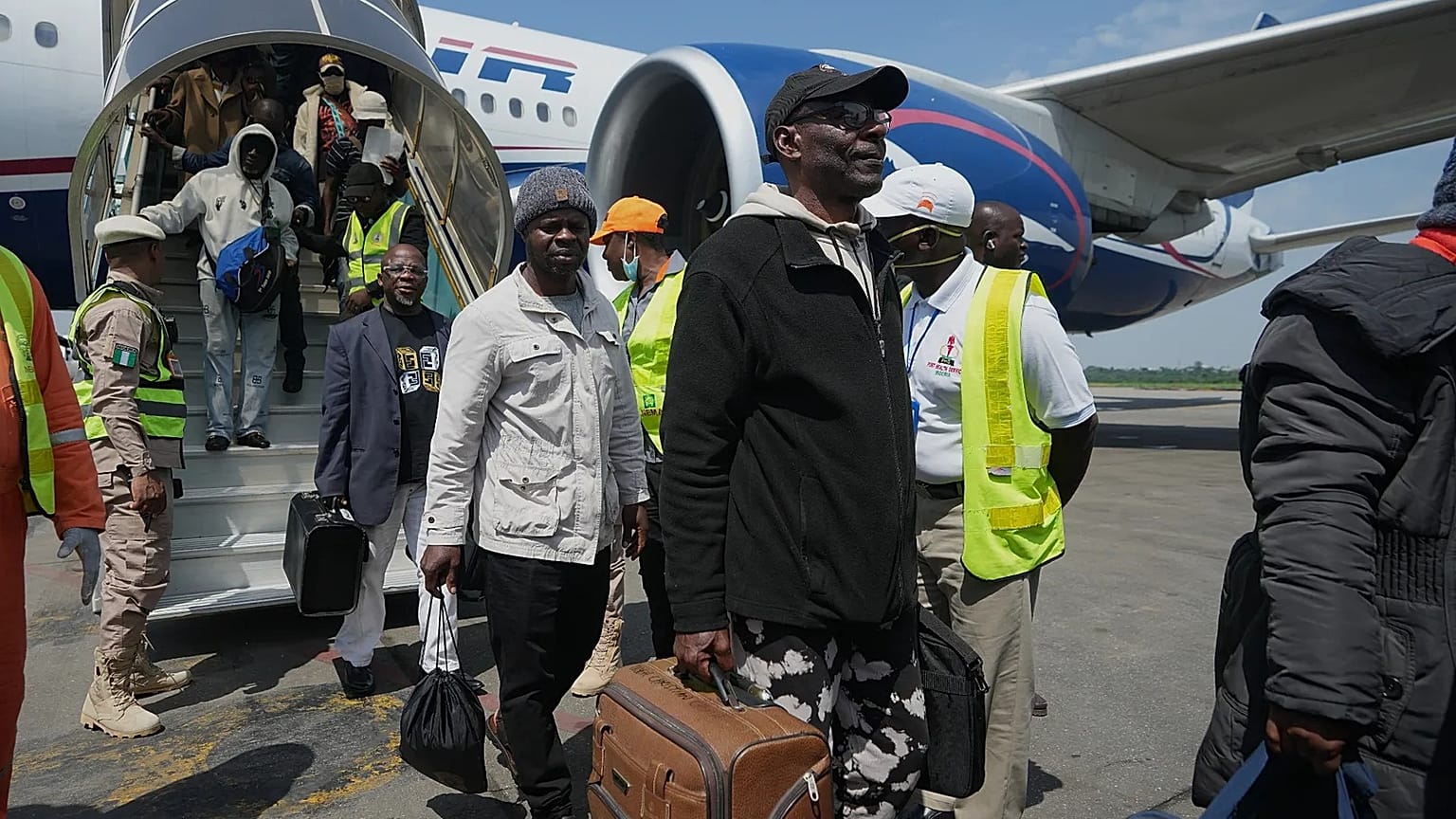
Nigeria’s operation has been the most visible. By July 1, the federal government had repatriated 603 citizens across three batches, and the effort did not stop there. A fourth Air Peace flight carrying 268 returnees and crew arrived in Lagos on Friday, July 3, with Foreign Minister Bianca Odumegwu-Ojukwu confirming that President Bola Tinubu had directed the evacuation to continue even after the June 30 deadline.
Elsewhere, the exodus moved by road as much as by air. Thousands of migrants, primarily from neighbouring Zimbabwe and Malawi, gathered at their embassies and consulates to request transport back to their countries, with buses carrying migrants leaving South Africa through the Beitbridge checkpoint on the Zimbabwe border.
BUSINESSES LOST, AND A BILL NOBODY WANTS TO PAY
Behind every returnee is an abandoned life: shops, cars, homes, years of work. Nigeria now wants that loss counted. Its acting High Commissioner said returnees were asked to document accurately the businesses, cars and immovable properties they were leaving behind, so Abuja could present them to the South African government for possible compensation. His reasoning was pointed: the labour people had spent years building would not be allowed to simply go down the drain.
That demand collides with Pretoria’s position. South African authorities have insisted the departures were voluntary, and have contested how some deaths were classified. The foreign ministry disputed government categorisations of some deaths as xenophobia-related rather than organised crime. The compensation question has become a live diplomatic sore.
THE STATE’S RESPONSE: FORCE, AND A FINE LINE
President Cyril Ramaphosa has walked an increasingly narrow path. He has repeatedly condemned attacks on foreign nationals, saying they do not reflect government policy, and blamed “opportunists who are exploiting the legitimate grievances, particularly those of the poor.” Yet he has also acknowledged “the challenge of illegal immigration,” saying undocumented migration places pressure on public services and distorts the labour market, while warning against making migrants scapegoats.
Enforcement, when it came, was heavy. South Africa said over 900 people were arrested during nationwide anti-migrant protests and police confirmed officers had been deployed across affected areas, with the government declaring June 30 a normal working day to blunt the deadline’s power.
WHY IT KEEPS HAPPENING
The recurrence is not mysterious. South Africa’s unemployment rate stood at 32% in the first quarter of 2026 after 350,000 jobs were lost, with young people hardest hit. More than three decades after apartheid, the country still grapples with deep inequality and one of the world’s highest murder rates. Into that frustration, vigilante movements offer a target.
Rights groups say the target is the wrong one. Amnesty International South Africa warned that scapegoating foreign nationals distracts from the government’s responsibility to address underlying problems, and that misinformation and xenophobia risk fuelling further violence. The courts have said as much: in November 2025, a High Court found Operation Dudula and its leadership guilty of intimidation, harassment and incitement of hate speech on grounds of nationality and ethnicity. What worries observers most is that even lawful migrants are now caught, groups have targeted foreign nationals whose presence complies with the law, verifying documents at workplaces and clinics. That is how xenophobia stops being an outbreak and becomes a climate.
CAN THE AFRICAN DREAM SURVIVE?
The founders of Pan-Africanism imagined a continent where a Nigerian, a Malawian, a Mozambican could build a life anywhere on African soil. In Johannesburg’s emptied shopfronts and Durban’s crowded fields, that ideal is being tested to its limit. South Africa is not turning inward out of malice alone — it is a society straining under real, unresolved economic pain. But a dream cannot hold if the dreamers no longer feel safe pursuing it. The question the coffins and the charter flights leave behind is uncomfortable and unavoidable: if Africa’s most industrialised nation cannot keep its fellow Africans safe, where, on this continent, can the African dream still live?