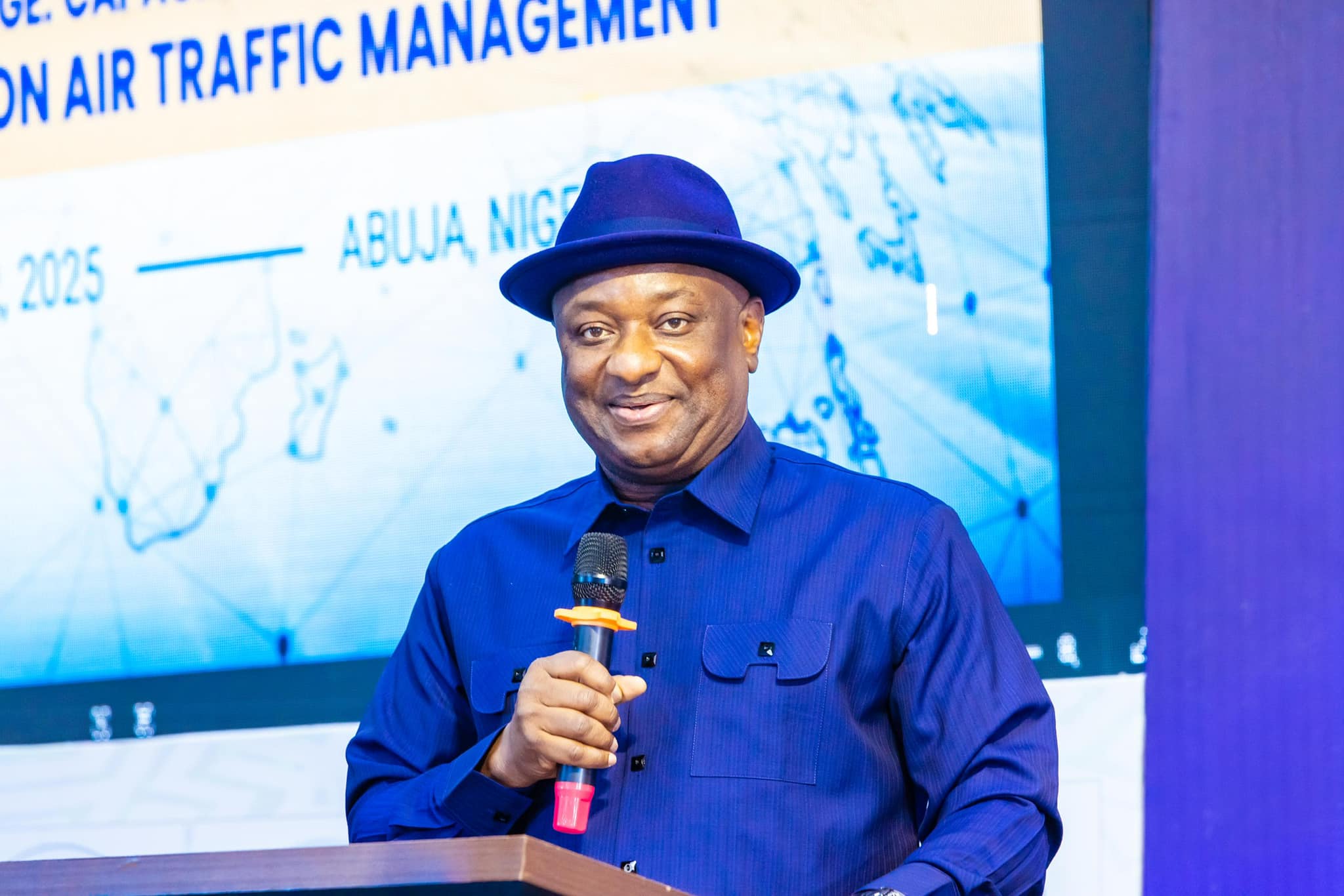
In the sweltering heat of Nigeria’s federal capital, where the hum of jet engines often drowns out the din of daily commerce, Festus Keyamo cuts an unlikely figure as the steward of Africa’s most populous nation’s skies.
A barrister by training, with a reputation forged in the courtroom battles of human rights advocacy, Mr Keyamo assumed the role of minister of aviation and aerospace development in August 2023 amid a sector battered by scandals, stranded funds and crumbling runways. Two years on, his tenure stands as a testament to the power of methodical reform in a continent where aviation ambitions frequently crash against the rocks of political expediency.
Mr Keyamo’s arrival was no soft landing. He inherited a ministry dogged by the ghost of the Nigeria Air project a $4bn venture shrouded in opacity, accused of favouring foreign interests over domestic carriers. With characteristic bluntness, he suspended it within weeks, citing irregularities that risked “entangling Nigeria in one-chance agreements”. The move, though lambasted by critics as a retreat, cleared the runway for transparency. It signalled to investors and operators alike that Mr Keyamo prioritises accountability over flashy headlines.
Yet it is in the quieter corridors of policy where Mr Keyamo’s impact resonates most profoundly. One of his earliest triumphs was the repatriation of some $800m in trapped funds owed to foreign airlines a backlog that had grounded routes and tarnished Nigeria’s global standing. Collaborating with the Central Bank of Nigeria, he unlocked these assets within months, coaxing carriers such as Emirates back to Lagos by October 2024. The result? A surge in international confidence, with Nigeria’s compliance rating under the Cape Town Convention the global framework for aircraft leasing leaping from 49.5 per cent to 75.5 per cent, the world’s sharpest climb. This ascent, propelled by the adoption of Irrevocable Deregistration and Export Request Authorisation rules, has lured dry-leased aircraft back to Nigerian fleets after two decades of exile.
Such metrics are not mere footnotes. They underpin a broader vision: positioning Nigeria as Africa’s aviation hub. In March 2025, Mr Keyamo inked a memorandum of understanding with Boeing to establish maintenance, repair and overhaul facilities on home soil a pact that promises to slash airlines’ costs by up to 40 per cent and generate thousands of skilled jobs. Complementing this, the Nigerian College of Aviation Technology in Zaria earned platinum status in the International Civil Aviation Organisation’s TRAINAIR PLUS programme, elevating local training to world-class standards.
“Human capacity is the engine of safety,” Mr Keyamo declared at the college’s recent oversight visit, underscoring his five-point agenda: compliance, infrastructure, local empowerment, security and sustainability
On the tarmac, too, progress is tangible. The long-stalled second runway at Abuja’s Nnamdi Azikiwe International Airport, mired in a seven-year land dispute with the Jiwa community, was resolved in a fortnight under Mr Keyamo’s negotiation. Borno’s airport, once a relic of conflict, now hums as a full international gateway, fostering trade in the north-east. And in Lagos, the remodelled arrival hall at Murtala Muhammed International a public-private partnership with the Nigerian Immigration Service has eased the crush for millions of passengers, though Mr Keyamo candidly admits the facility still lags global benchmarks.
But ascent is not without turbulence. High operational costs, exacerbated by naira’s volatility and aviation fuel priced at thrice the global average, continue to throttle local carriers. Flight delays and cancellations persist, often without notice, eroding passenger trust. Infrastructure demands outpace budgets; Mr Keyamo’s push for the Fly Nigeria Act to mandate government travel on domestic airlines awaits National Assembly approval, a process that could snag on vested interests. Critics whisper of over-reliance on bilateral air service agreements, with expansions to the UAE and Canada risking lopsided benefits for foreign rivals.
Mr Keyamo dismisses such barbs with data.
At a judges’ conference this month, he urged judicial collaboration to enforce aviation treaties, framing judges as “ambassadors of Nigeria’s honour” on the global stage. His latest flourish: partnering with the Federal Capital Territory Administration for Nigeria’s inaugural international airshow in Abuja next year, a centenary celebration timed to showcase a sector reborn.
In a nation where ministers often promise the stars but deliver dust, Mr Keyamo’s ledger is one of substance over spectacle. As Nigeria eyes the Single African Air Transport Market, his reforms could yet propel it from continental contender to global player. The skies, it seems, are clearing but only if the headwinds of economic reform do not ground the flight anew. For now, passengers boarding from Lagos to London can board with cautious optimism.