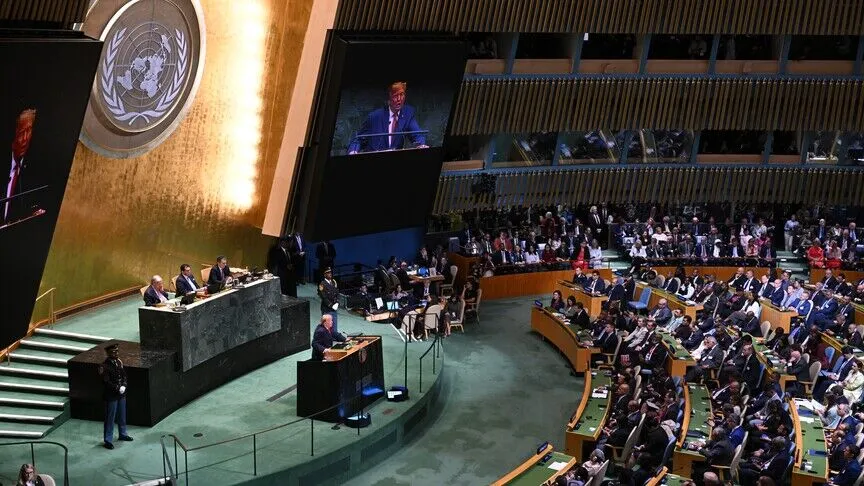
The 81st United Nations General Assembly (UNGA 81) took place against a backdrop of international fragmentation, economic uncertainty, climate pressure, and growing questions about whether existing global institutions still reflect today’s balance of power. Held under the theme “Restoring Trust, Managing Transformation: A United Nations That Delivers for All,” the session placed several issues of direct importance to Africa at the centre of international debate.
For Africa, however, UNGA 2026’s significance goes beyond speeches in New York. It raises a more fundamental question: is Africa prepared to move from demanding a greater role in the international system to using that role to advance concrete economic and strategic aims?
- Security Council Reform Remains Africa’s Biggest Institutional Demand
One of Africa’s clearest messages at UNGA 2026 was the renewed demand for UN Security Council reform.
African leaders again stressed the continent’s absence from the Council’s permanent membership despite Africa being the largest regional bloc in the UN by number of member states and a major focus of UN peacekeeping. The UN General Assembly president himself identified Africa’s underrepresentation as an urgent reform issue.
The significance goes beyond symbolism.
African countries are frequently affected by the conflicts and security crises the Security Council discusses—from Sudan and the Sahel to the Great Lakes and the Horn of Africa—yet the continent lacks a permanent voice with veto power.
The lesson from UNGA 2026 is therefore straightforward: representation is increasingly being treated as a question of decision-making power, not diplomatic prestige.
- Africa’s Financial Problem Is Becoming a Global Governance Problem
African governments also used UNGA to highlight weaknesses in the international financial architecture.
The UN’s Office of the Special Adviser on Africa identified debt vulnerability, heightened borrowing costs, credit-rating methodologies and the redistribution of Special Drawing Rights as major African priorities.
This matters because development is difficult when governments spend large portions of their revenues servicing expensive debt rather than financing infrastructure, healthcare, education and industrialisation.
UNGA 2026 therefore reinforced an important shift in the African conversation: development assistance alone is insufficient. Africa is increasingly seeking changes to the rules governing how development is financed.
The challenge will be converting this diplomatic consensus into mechanisms that actually lower the cost of capital and expand productive investment.
- Critical Minerals Are Moving from Resource Issue to Industrial Strategy
Another important takeaway is the growing connection between Africa’s mineral wealth and the global energy transition.
Africa possesses significant reserves of minerals critical to batteries, renewable energy, electric vehicles and advanced technologies. But the central African concern is not simply how much mineral wealth the continent possesses. It is where it creates value.
The AU and UN specifically pointed out the need for Africa to derive greater value from critical minerals, while African governments continued to push for domestic processing and industrialisation.
This creates a tactical choice.
Africa can remain primarily an exporter of raw materials, or attempt to develop processing, manufacturing and supporting industries around those resources.
The second route is considerably more difficult because it requires electricity, transport infrastructure, skills, capital, technology and stable regulatory systems. But without value addition, the energy transition could reproduce the same commodity-export model that has consistently limited industrial transformation across much of the continent.
- Climate Change Is Also an Economic and Security Issue
Africa’s climate argument at UNGA 2026 was closely connected to development.
The continent contributes relatively little to global emissions yet faces disproportionate exposure to climate-related risks, including droughts, floods, food insecurity and displacement. African priorities therefore included adaptation finance, loss-and-damage commitments and climate resilience.
But there is another dimension.
Climate stress can compound existing economic and security vulnerabilities. Disrupted agricultural production can increase food prices; water scarcity can worsen local competition; extreme weather can destroy infrastructure and push at-risk populations into displacement.
For African policymakers, climate policy therefore cannot be treated simply as an environmental agenda. It increasingly overlaps with food security, public finance, migration, employment and national security.
- Peace and Security Require More African Ownership
UNGA 2026 additionally underscored the continuing security challenges confronting the continent, particularly in the Sahel, Sudan, Somalia, Libya, South Sudan and the Democratic Republic of Congo.
The AU and UN reaffirmed the importance of African-led peace and security initiatives, preventive diplomacy and stronger support for Africa’s own peace and security architecture.
The underlying issue is one of capacity.
Political ownership without adequate financing, logistics and institutional capability can produce limited results. Africa therefore needs not only greater responsibility for resolving its conflicts but also the financial and institutional tools to exercise that responsibility effectively.
This could become increasingly important as worldwide attention and resources are strained by conflicts outside Africa.
- Technology and AI Are Emerging as New Areas of African Diplomacy
AI and digital transformation also featured prominently in the 2026 UN agenda. The General Assembly president’s programme specifically included digital governance, artificial intelligence, science and technology and closing the digital divide.
For Africa, this matters even more.
The continent is both a potential consumer, workforce, and market for AI and faces major gaps in digital infrastructure, computing capacity, technical skills, and access to capital.
African participation in AI governance therefore matters because decisions about data, automation, digital infrastructure and emerging technologies could influence the continent’s economic path for decades.
The message from UNGA is that Africa cannot afford to be merely a market for technologies whose rules are written elsewhere.
- Africa’s Biggest Opportunity May Be Collective Bargaining Power
Perhaps the wider lesson from UNGA 2026 is that Africa’s influence depends heavily on its ability to act collectively.
The African Union represents 55 states and can therefore give the continent significant negotiating weight on issues such as trade, climate finance, critical minerals, debt reform, technology, and global governance.
The AU’s stated approach at UNGA 81 was explicitly framed around presenting Africa not simply as a recipient of international assistance but as a strategic partner in confronting global challenges.
The difficulty is translating this collective position into coordinated national policies.
If African countries compete against one another for investment by offering increasingly generous concessions, the continent’s bargaining power can weaken. If they coordinate around common standards, regional value chains, and shared infrastructure, their negotiating position can become considerably stronger.
Conclusion: From Being Heard to Being Able to Deliver
UNGA 2026 offered Africa another opportunity to articulate its grievances and ambitions: greater representation, fairer financing, climate justice, control over natural resources, stronger security cooperation, and a meaningful role in technological governance.
But the more important question begins after the UNGA speeches.
Can African governments convert diplomatic demands into domestic capacity?
Security Council reform will not by itself resolve insecurity. Critical minerals will not automatically produce jobs. Climate finance will not automatically create resilience. Digital access will not automatically produce competitive technology industries. And financial reform will have limited effect without stronger domestic institutions.
The central takeaway from UNGA 2026, therefore, is that Africa’s global influence will increasingly depend on the relationship between its diplomatic voice and its economic, technological and institutional capacity.
The continent is demanding a larger seat at the table. The next task is to ensure that, when that seat becomes available, Africa arrives with the coordination, capital, and industrial strategy necessary to use it.