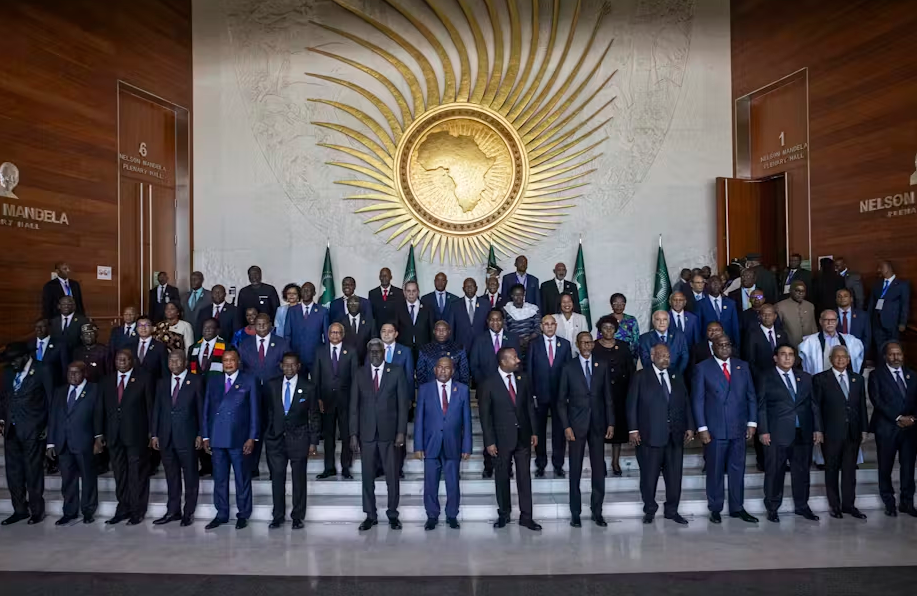
Africa’s pan-national institutions, from the African Union (AU) to regional blocs like ECOWAS and the East African Community (EAC), aim to foster unity and self-reliance. Yet, their heavy reliance on foreign funding undermines their autonomy and shapes their agendas to suit external interests.
The AU’s Donor Dilemma
In 2022, 66% of the AU’s $650 million budget came from external donors, with member states covering just a third. Former AU Commission Chairperson Moussa Faki Mahamat noted that 70% of financing still flows from outside, including full funding for recent peacekeeping missions. A 2017 plan to fund 75% of the AU’s budget through a 0.2% trade levy has faltered, leaving the bloc dependent on foreign cash.
This imbalance grants donors primarily the EU, U.S., China, and India significant influence. In 2025, only 32.9% of the AU’s budget came from African countries, while 58.1% was from external partners. Donors often tie aid to their priorities: the EU pushes economic reforms, the U.S. demands governance standards, and China and India leverage infrastructure deals for diplomatic sway. As one insider noted, the AU’s budget is often a “farce,” with off-books donor funds obscuring true financial control.
Analysts like Denis Andaban argue that African governments have grown complacent, accepting aid with hidden conditions that advance foreign interests. Ugandan scholar Fred Muhumuza warns that donors can “turn off” aid to enforce compliance, while writer Mo Ibrahim calls the AU’s dependency a threat to its credibility. The AU president increasingly spends time courting donors, who expect influence over programs, appointments, and reforms.
African Development Bank: African Roots, Foreign Influence
The African Development Bank (AfDB), Africa’s premier development lender, faces similar challenges. Non-African countries hold nearly 40% of its voting power, giving nations like the U.S., Japan, and EU members outsized influence over leadership and policy. In 2020, the U.S. under President Trump tried to block AfDB President Akinwumi Adesina’s re-election, demanding further investigations despite his clearance by an ethics committee. African leaders, including Nigeria, decried this as a “North Atlantic” power play. Adesina prevailed, but the episode highlighted external sway.
The AfDB’s concessional arm, the African Development Fund (ADF), relies on donor replenishments. In 2023–2025, the U.S. pledged $568 million, second only to the UK. A proposed $555 million cut by the U.S. in 2025 threatens a funding crisis, pushing the AfDB to seek new donors like China or Gulf states, each with their own geopolitical agendas. Former World Bank VP Samuel Maimbo warns that shifting to non-Western capital could realign the Bank’s priorities, as its 27 non-regional members already risk skewing its focus.
Regional Blocs: Vulnerable to External Pressure
Regional bodies like ECOWAS and the EAC also grapple with dependency. ECOWAS claims 90% self-financing through a community levy, but the remaining 10% from donors especially the EU wields disproportionate influence in security, elections, and infrastructure. The bloc’s reliance on Nigeria and Ghana for dues makes it vulnerable to external leverage.
The EAC is even more dependent, with donors funding 40–45% of its budget, up from 15% in the early 2000s. Major backers like the EU, World Bank, USAID, and Japan support critical programs, from railways to health reforms. EAC staff admit this “over-dependency” constrains independence, with development paths often shaped in Brussels, Beijing, or Washington rather than Arusha or Kampala.
Major Donors, Competing Agendas
Africa’s financial landscape is shaped by key players with distinct priorities:
- China: Africa’s largest bilateral partner, pledging $50 billion in 2024, focuses on infrastructure like roads and telecoms. Its “no political conditions” loans, accounting for 17% of sub-Saharan Africa’s external debt, grant Beijing soft power but raise transparency concerns.
- European Union: The EU funds AU peacekeeping and regional programs, tying aid to governance and market reforms through initiatives like Global Gateway. Budget cuts and Ukraine commitments have tightened its purse strings, increasing its role as a gatekeeper.
- United States: Through USAID and multilateral channels, the U.S. influences policy via security missions and governance initiatives. Its proposed 2025 AfDB funding cut underscores its leverage.
- World Bank: Its debt sustainability rules and co-financing with the AfDB shape African fiscal policy, with U.S. and EU shareholding amplifying their influence.
A Path to Self-Reliance?
African leaders are vocal about the problem. Ghana’s former president Nana Akufo-Addo called dependency a threat to national dignity, while AfDB President Adesina declared in 2025 that “the era of aid is gone.” Economists like Denis Andaban urge practical steps: better tax collection, regional capital markets, and intra-African investment. Some propose AfDB reforms to attract Gulf or private capital, while others see South-South partnerships as alternatives to Western aid.
Yet, with many African governments relying on foreign aid for up to 50% of their budgets, breaking free remains daunting. Africa’s institutions manage vast mandates, peacekeeping, trade, infrastructure but lack independent financing. As one expert asks, “What happens when the cheque comes with strings?” Without bold reforms, foreign influence will continue to shape Africa’s future.