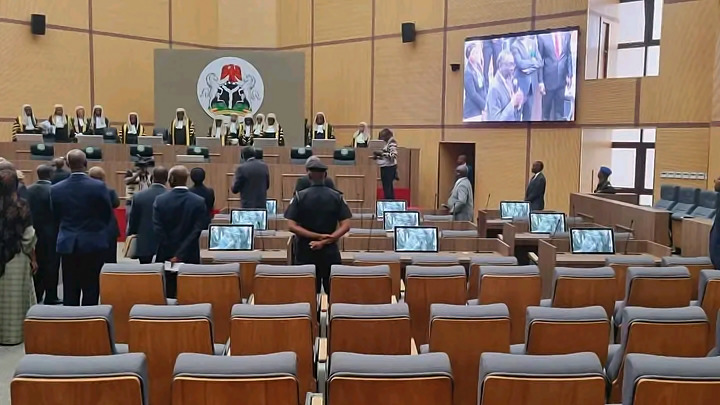
Nigeria’s democracy is currently navigating a strange, litigious twilight zone. In a landscape where the ballot box should be the ultimate arbiter of power, the courtroom has emerged as the primary theater of war.
Since President Bola Ahmed Tinubu took the oath of office nearly two years ago, a troubling pattern has solidified: internal party squabbles, once settled by elders in smoky rooms or through convention votes, are now spilling onto the dockets of High Courts with alarming frequency. The result is a political ecosystem where the “Rule of Law“ feels increasingly like the “Rule of Litigation.”
THE ANATOMY OF A JUDICIAL CRISIS
Across the ideological spectrum, the script is almost rhythmic. A leadership crisis erupts; factions dash to secure an ex parte motion; and the courts respond with rulings that are often interim, occasionally contradictory, and almost always inflammatory. Rather than cauterizing the wounds of internal dissent, these judicial interventions often act as a wedge, deepening fractures until political parties are reduced to hollowed-out shells of their former selves.
THE NARRATIVE OF TILTED SCALES
Beneath the dense legalese, a more cynical narrative is gaining momentum. Opposition figures and legal analysts are increasingly pointing to a pattern that suggests this judicial chaos serves a specific purpose. There is a growing perception – unproven but potent – that the frequent “confusion“ within the courts tends to favor the ruling All Progressives Congress (APC).
As Nigeria inches toward the 2027 general elections, the perception of a weaponized judiciary is becoming as influential as the law itself. When the neutral arbiter is viewed as a participant, the institutional foundation of the state begins to creak under the pressure.
A TALE OF TWO FRACTURES: PDP AND ADC
- The PDP Paralysis: Once a “behemoth“ that dominated the African political landscape, the People’s Democratic Party is now a textbook case of judicial stagnation. Parallel leadership claims, bolstered by competing court orders, have left the party in a state of permanent uncertainty. In this vacuum of authority, the opposition’s ability to provide a credible check on the government has effectively vanished.
- The ADC Battlefield: The African Democratic Congress (ADC) offers an even more granular look at this trend. What was once positioned as a potential coalition hub for the 2027 cycle has devolved into a legal quagmire. Here, the power of “recognition“ by the Independent National Electoral Commission (INEC) is the ultimate prize.
- The Red Flag: Legal experts are particularly baffled by cases where appeals deemed “incompetent“ are dismissed with consequential orders that carry heavy political weight. When the umpire (INEC) interprets ambiguous court orders in ways that weaken opposition structures, the electoral map is effectively rewritten before a single vote is cast.
LITIGATION AS A TACTICAL WEAPON
In modern Nigeria, a lawsuit is no longer a last resort; it is a tactical opening move. For savvy political actors, litigation is a tool used to:
1. Stall Opponents: Tie up rivals in procedural loops that drain resources.
2. Fragment Cohesion: Create enough legal doubt to scare off donors and grassroots supporters.
3. Sideline Platforms: Force parties to miss crucial INEC deadlines for membership registers or primaries. A delay in the courtroom today is an exclusion from the ballot tomorrow.
THE COST TO THE VOTER
The ultimate casualty of this “Democracy by Decree“ is the Nigerian voter. When the field of choice is narrowed by judges rather than delegates, the democratic process loses its soul. A political landscape shaped by courtroom maneuvers rather than competing visions risks eroding what little remains of public confidence in the system.
The courts are meant to be the “last hope of the common man.“ But as they become more deeply embedded in the machinery of party politics, a haunting question remains: are they resolving the crisis, or have they become the crisis itself?
As we look toward 2027, given the current trend of judicial intervention, what do you think is the biggest hurdle for a unified opposition to overcome?