
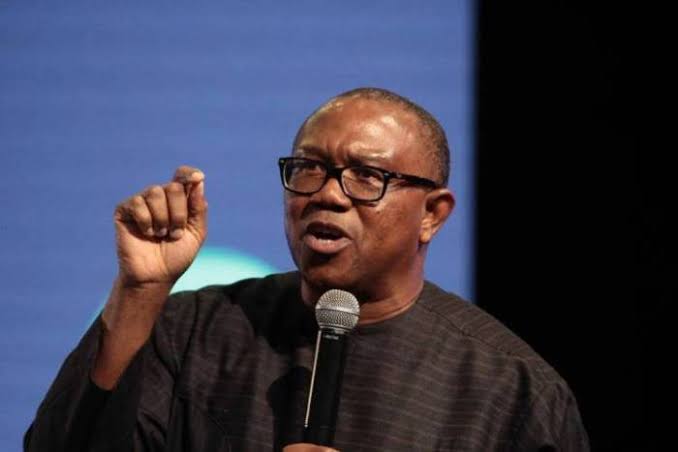
In Nigerian politics, elections are often decided long before the first ballot is cast. By the time voters troop to polling units, the real battle may have already be fought: in courtrooms, in party secretariats, in coalition meetings, and in carefully engineered internal crises that leave opponents too weak to compete. As the road to 2027 gradually takes shape, one name continues to dominate opposition calculations: Peter Obi.
For President Bola Ahmed Tinubu, the challenge may not simply be how to defeat Obi at the polls, but how to ensure Obi never gets there in the first place.
The silent political war unfolding across Nigeria’s opposition landscape suggests a deeper strategy: weaken the man by destabilizing the platform, isolate the candidate by dividing the coalition, and, if necessary, remove the possibility of his name appearing on the ballot entirely.
This is not merely an election strategy. It is political survival at its highest level.
THE MAN THE ESTABLISHMENT STILL FEARS
Despite losing the 2023 presidential election, Peter Obi remains arguably the most potent opposition figure in Nigeria today.
His appeal cuts across demographics that traditional politicians struggle to command: young voters, urban professionals, middle-class Nigerians, frustrated first-time voters, and a growing population of citizens disillusioned with the old political order. Unlike many opposition figures whose influence fades after defeat, Obi’s political relevance has only deepened.
His supporters remain emotionally invested. His message of fiscal discipline, governance reform, and institutional accountability still resonates. More importantly, he represents something dangerous to entrenched political interests: a candidate whose popularity is not entirely dependent on traditional godfather structures.
That makes him a problem.
And in Nigerian politics, serious problems are rarely confronted only at the ballot box.
LABOUR PARTY: THE FIRST BATT
The first major front in this political war was the Labour Party.
After the 2023 election, rather than consolidating around its strongest political asset, the party descended into prolonged internal conflict: leadership disputes, factional battles, legal controversies, and public accusations that damaged both credibility and momentum.
For a movement that had relied heavily on public enthusiasm and grassroots energy, institutional instability proved devastating.
Questions emerged: Who truly controlled the party? Who had authority to speak for it? Could Obi trust the structure enough to run again under the same platform?
These were not minor administrative disagreements. In Nigeria’s electoral system, party structure is everything. Without control of delegates, national leadership, and legal legitimacy, even the most popular candidate can be politically stranded.
The crisis weakened not just Labour Party; it weakened Peter Obi’s route to 2027.
And for the ruling APC, there could be no better outcome.
CHAOS AS A POLITICAL WEAPON
Politics is often less about direct confrontation and more about strategic advantage.
No serious observer of Nigerian politics ignores the possibility that ruling party interests benefit from opposition fragmentation. Whether through influence, alliances, silent encouragement, or simple exploitation of existing weaknesses, the result is often the same: divided opponents and a stronger incumbent.
Tinubu is not merely a president; he is one of the most experienced political strategists Nigeria has produced. His rise to power was built not just on popularity, but on structure, alliances, timing, and deep institutional control.
He understands what many idealists ignore: elections are won by systems, not sentiments.
If the opposition is fighting itself, the incumbent hardly needs to fight them.
This is where Labour Party’s implosion becomes politically significant. Whether directly engineered or simply opportunistically exploited, the outcome serves the same purpose: Peter Obi becomes less dangerous.
ADC: THE NEW FRONTLINE
As conversations around opposition coalitions intensified, attention shifted to the African Democratic Congress (ADC), seen by some as a possible alternative platform for realignment.
For Obi and other opposition figures, coalition politics may be the only realistic path to challenging the APC’s national machinery. No single opposition bloc can easily defeat a sitting president with deep institutional reach.
But coalition politics is fragile.
It requires trust, sacrifice, compromise, and, above all, stability. Once suspicion enters the room, alliances collapse.
The emerging tensions around coalition discussions and ADC positioning raise familiar questions: Can opposition leaders unite before personal ambition destroys the project? Can a credible anti-Tinubu front emerge without being internally sabotaged?
Or is the same pattern repeating itself: another platform weakened before it can mature?
If Labour Party was the first battlefield, ADC may be the second.
And the objective remains unchanged: prevent a united opposition around Peter Obi.
WHY REMOVING OBI IS BETTER THAN DEFEATING HIM
For the ruling establishment, defeating Peter Obi in an election carries risks.
Campaigns energize movements. Ballots create legitimacy. Even defeat can strengthen political capital if the candidate emerges as a symbol of resistance.
But preventing him from appearing on the ballot is cleaner.
No campaign. No national momentum. No mass mobilization. No symbolic confrontation.
Just procedural defeat.
Party disputes. Legal disqualification. Structural collapse. Coalition failure.
Victory without electoral warfare.
This is the more sophisticated political calculation.
It is not enough to beat the opponent. The ideal strategy is to ensure the opponent never fully arrives.
TINUBU’S POLITICS OF CONTROL
President Tinubu’s greatest strength has never been public sentiment; it has always been political control.
He understands party machinery. He understands elite negotiation. He understands that loyalty is often transactional and that stability is power.
While opposition parties battle over leadership legitimacy, the APC projects order. While rivals negotiate survival, the presidency projects continuity.
In a country exhausted by economic pain and political uncertainty, stability itself becomes a campaign message.
Tinubu’s argument for re-election may not rest solely on performance, but on inevitability: he is the only candidate with the structure, reach, and institutional capacity to govern.
Everyone else is presented as fragmented.
That perception matters.
Because in politics, viability can become self-fulfilling.
HISTORY REPEATING ITSELF
Nigeria has seen this before.
Strong opposition figures are often weakened before election season fully begins. Sometimes through legal technicalities. Sometimes through party implosion. Sometimes through strategic defections that leave them politically isolated.
The battlefield is rarely only democratic; it is procedural.
By the time the public notices, the decision has often already been made.
The lesson is simple: if you cannot defeat the movement, disrupt the vehicle carrying it.
That lesson appears alive in 2027 calculations.
THE REAL CONTEST AHEAD
The true contest may not be Tinubu versus Obi.
It may be structure versus popularity.
Institution versus momentum.
Political machinery versus emotional mass support.
Peter Obi still has public sympathy. But sympathy does not print ballot papers. It does not settle party leadership disputes. It does not survive prolonged institutional sabotage.
To challenge Tinubu seriously, Obi must first survive the politics before politics.
That may be the hardest election of all.
As 2027 approaches, the most important political question may not be who will defeat President Tinubu.
It may be whether Peter Obi will even be allowed a clear path to try.
From Labour Party’s crisis to ADC’s uncertainty, the pattern suggests a broader strategy, one that prioritizes eliminating threats before campaigns begin.
If that strategy succeeds, Tinubu may not simply win re-election.
He may enter the race as the only truly viable candidate left standing.
And in Nigerian politics, that is often the most decisive victory of all.