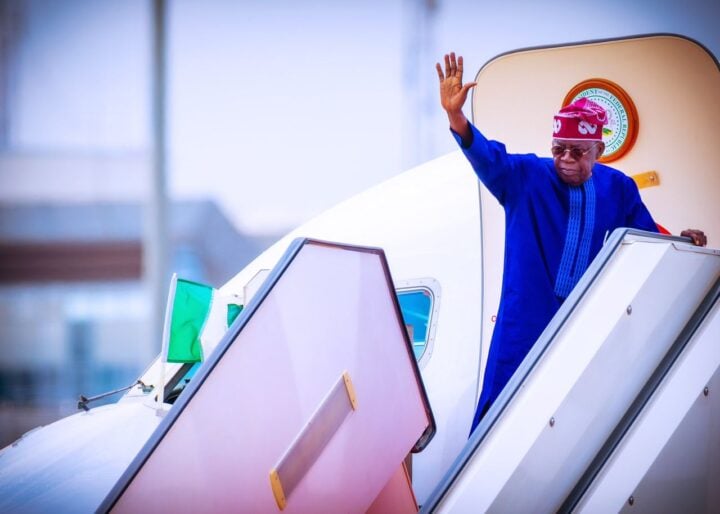
As Nigeria prepares to close out the first half of President Bola Ahmed Tinubu’s term, the national conversation has taken to the skies. The presidential jets, symbols of executive mobility, have logged more international miles than many Nigerians have seen in a lifetime of domestic travel. While the country confronts overlapping crises – insecurity that refuses to abate, inflation that devours savings, and poverty that deepens by the day – the leader charged with steering the nation appears more often on foreign tarmacs than in the familiar corridors of Aso Rock.
The criticism crystallized late last year when Peter Obi, the Labour Party’s 2023 presidential candidate and a persistent voice of opposition, tallied the president’s whereabouts for 2025. According to Obi’s widely cited claim, Tinubu spent 196 of the year’s 365 days outside Nigeria – more time abroad than at home during one of the most turbulent periods in recent memory. Whether the exact figure holds under scrutiny or not, the perception it fuels is unmistakable: a leadership that feels remote at precisely the moment when proximity, visibility, and reassurance matter most.
The financial toll sharpens the picture. In the 2026 federal budget, presented in late 2025, the presidency has allocated approximately ₦7.01 billion for President Tinubu’s travel and transport, with roughly ₦6.14 billion earmarked for international trips alone. Add the vice president’s provisions and those for senior aides, and the total presidential travel budget climbs to about ₦12.2 billion. Separately, an estimated ₦6 billion is set aside for maintaining and overhauling the presidential aircraft fleet, including costly engine servicing. These sums arrive against a backdrop of severe underfunding in health, education, and security – sectors where millions of Nigerians confront daily shortages of medicine, classrooms, and adequate policing.
The contrast is painful. Banditry and kidnappings continue to scar the countryside; food prices remain punishing; and the ranks of the poor swell. In such circumstances, the optics of sustained foreign engagement – however strategic – risk being read as detachment. Obi has framed the issue starkly: effective governance in a crisis demands presence, direct communication, and empathy, none of which flourish when the head of state is frequently unreachable or explaining events from afar. He has questioned not the value of diplomacy itself, but the balance of priorities when domestic emergencies mount without commensurate presidential attention on the ground.
Defenders of the administration push back with conviction. Official spokespeople maintain that Tinubu’s travels serve clear national interests: courting foreign investment, fortifying bilateral ties, and repositioning Nigeria in a competitive global economy. They highlight measures to trim delegation sizes and curb excesses, arguing that these outings have already yielded measurable gains in trade, portfolio inflows, and diplomatic leverage. In their view, the president remains engaged remotely, directing affairs through secure channels even while airborne.
Yet perception is a political reality of its own. In a nation where leaders have historically been judged by their visibility – by town halls attended, crises witnessed firsthand, and citizens comforted directly – prolonged absence carries weight. Quiet unease has surfaced even among some within the ruling circle, who recognize that optics can erode trust faster than policy successes can rebuild it.
With the 2027 elections looming and Tinubu’s first term entering its decisive phase, the debate over presidential travel has become a shorthand for deeper anxieties about governance, accountability, and connection. The question is less whether a president should engage the world – few would argue against that – than whether a nation grappling with so many urgent, homegrown challenges can sustain a leadership style that often seems to operate at 30,000 feet.
Nigeria needs its president to meet the world, yes. But it also needs him to meet its people where they stand – on the ground, amid the struggles that define their days. The balance between those imperatives will help determine not only the political weather ahead, but the trajectory of a country that can ill afford to feel leaderless at home while its leader is elsewhere.