
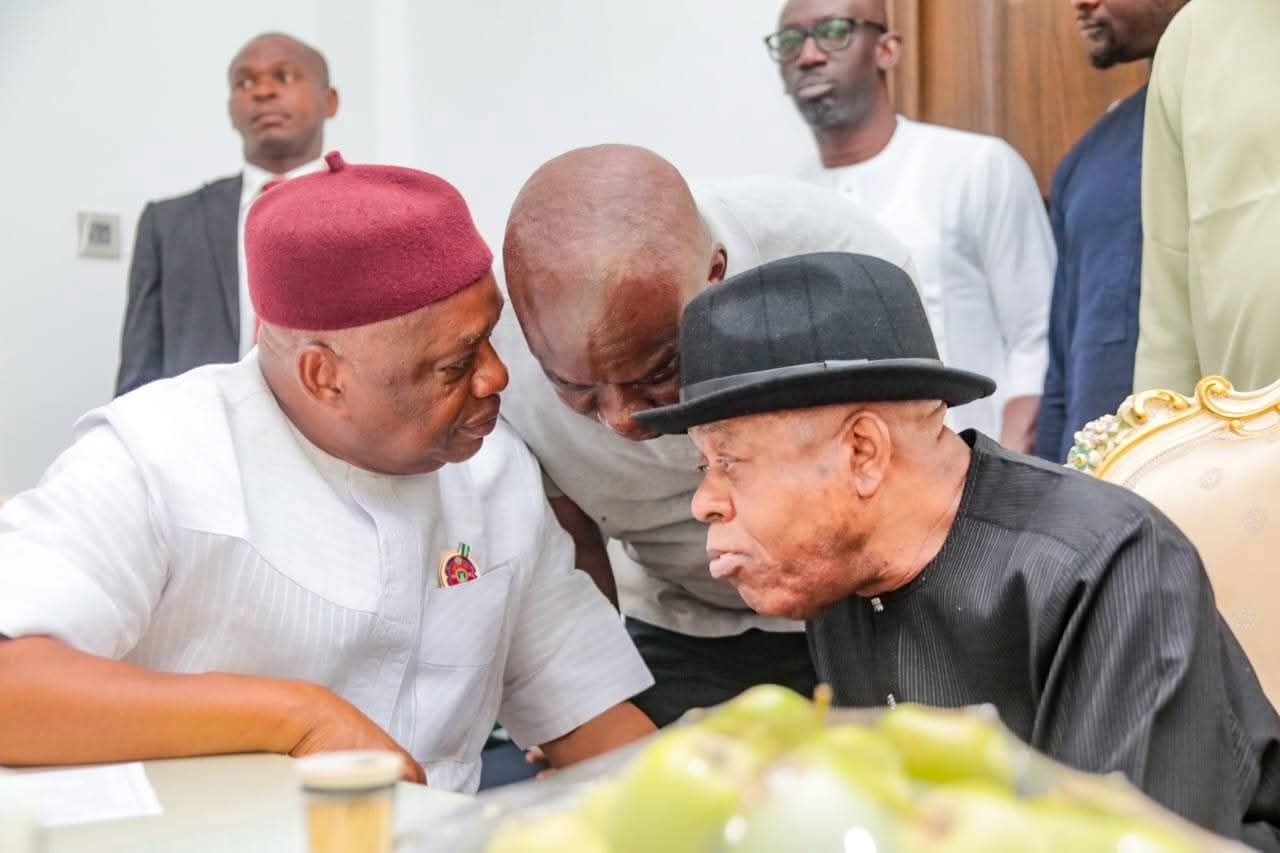
The past three governors of Abia State before the current administration of Dr. Alex Otti presided over what many Abians now regard as a prolonged era of governance failure, marked by pervasive criminality, institutional decay, and the systematic looting of public resources. From 1999 to 2023, Orji Uzor Kalu (1999–2007), Theodore Orji (2007–2015), and Okezie Ikpeazu (2015–2023) held sway under the dominant Peoples Democratic Party (PDP) umbrella, handing power to one another in what critics describe as a relay race of mediocrity and self-enrichment.
This 24-year period turned what could have been a prosperous state – blessed with commercial hubs like Aba, human capital, and natural resources – into a national byword for underdevelopment, unpaid salaries, dilapidated infrastructure, and unchecked corruption.
Orji Uzor Kalu, the first civilian governor of the Fourth Republic in Abia, set the tone for the era’s excesses. His eight-year tenure was overshadowed by allegations of massive fraud, culminating in a high-profile conviction (later nullified on procedural grounds) for defrauding the state of billions through his family company, Slok Nigeria Limited. Investigations revealed how state funds were allegedly diverted on an industrial scale, with reports linking him to multimillion-dollar property acquisitions abroad even amid ongoing probes. Despite denials and legal maneuvers, the pattern was clear: public treasury treated as private patrimony, leaving behind a legacy of abandoned projects and a state teetering on the edge of insolvency.
The baton passed to Theodore Orji, who served two terms and deepened the rot. Recent developments have seen the Economic and Financial Crimes Commission (EFCC) arraign him, alongside his son Chinedum Orji and others, on staggering charges involving the alleged misappropriation of over N60 billion. The accusations span conspiracy, stealing, and conversion of funds meant for security votes, Paris Club refunds, ecological projects, SME support, and more. These funds, intended for public welfare, were allegedly diverted, contributing to the collapse of basic services and the near-total neglect of infrastructure. The arraignment underscores a bipartisan recognition that the era’s governance was not merely incompetent but criminally negligent.
Then came Okezie Ikpeazu, whose administration faced relentless scrutiny for financial irregularities. Forensic audits commissioned after his exit revealed hundreds of billions in contracts awarded without corresponding execution, unpaid worker salaries, pensioner suffering, and a general atmosphere of financial opacity. While Ikpeazu has vehemently denied wrongdoing – dismissing many claims as politically motivated or mathematically impossible – the public record shows a state that remained mired in debt, poor roads, and zero service delivery, with little evidence of meaningful progress despite substantial revenue inflows.
In a bold move to end the era of elite entitlement, Governor Alex Otti – who has consistently positioned himself as a champion of fiscal prudence and stewardship – signed into law in March 2024 the repeal of the Abia State Governors and Deputy Governors Pensions Law. This scrapped the controversial lifetime pensions and lavish entitlements previously enjoyed by former governors and their deputies, redirecting scarce resources toward clearing arrears owed to ordinary pensioners and civil servants who had suffered for decades. Notably, Otti explicitly stated that the reform applied to him as well upon leaving office, declaring that true leadership is about service, not self-enrichment. Former President Olusegun Obasanjo publicly hailed the decision as a courageous step against “daylight robbery,” urging other states to follow suit.
Collectively, these three administrations presided over Abia’s dark age: a time when salaries went unpaid for months, pensioners died in penury, Aba’s commercial potential was squandered, and the state became synonymous with failure. Allegations of corruption were not isolated incidents but systemic, with billions allegedly siphoned through inflated contracts, security vote abuses, and diversion of federal allocations. The result was a demoralized populace, collapsed institutions, and a state that lagged far behind its peers in the Southeast.
The contrast with the current leadership under Alex Otti is stark and undeniable. Since assuming office in 2023, Otti has prioritized accountability, infrastructure renewal, worker welfare, and transparent governance – reversing decades of neglect in record time. Yet, the architects of the old order now seek a return. In early January 2026, former governors Orji Uzor Kalu, Theodore Orji, and Okezie Ikpeazu – along with their allies – convened strategic meetings in Umuahia, forming a coalition dubbed “The Team” to orchestrate Otti’s ouster ahead of the 2027 governorship election. Their declared aim: reclaim power, expand their influence across party lines, and challenge the progress made under Otti, even as they pursue legal actions against him over unrelated matters like his choice of residence for official duties.
But Abians have not forgotten the pain of the past 24 years. The people of Abia have vowed to resist any such opposition against Alex Otti and to thwart the political ambitions of these former leaders, whom many label as criminal politicians responsible for the state’s long suffering. Public sentiment, amplified across social media and community gatherings, reflects a firm resolve: no return to the days of looting and neglect. As Otti himself has dismissed these gatherings as the “empty noise” of self-interested “empty barrels,” Abians stand united in declaring that the era of failed leadership is over.
Abians deserve better than a return to the failed playbook of the past. The era of the three predecessors stands as a cautionary tale: when leadership prioritizes personal gain over public good, the consequences endure for generations. True progress demands accountability, not amnesia. As Abia finally awakens under Otti, the lessons of this troubled history – and the people’s unwavering support – must remain etched in collective memory to prevent any relapse in 2027 and beyond.